.png)
CAPITAL DOESN’T SOLVE WHAT CAPITALISM KILLS

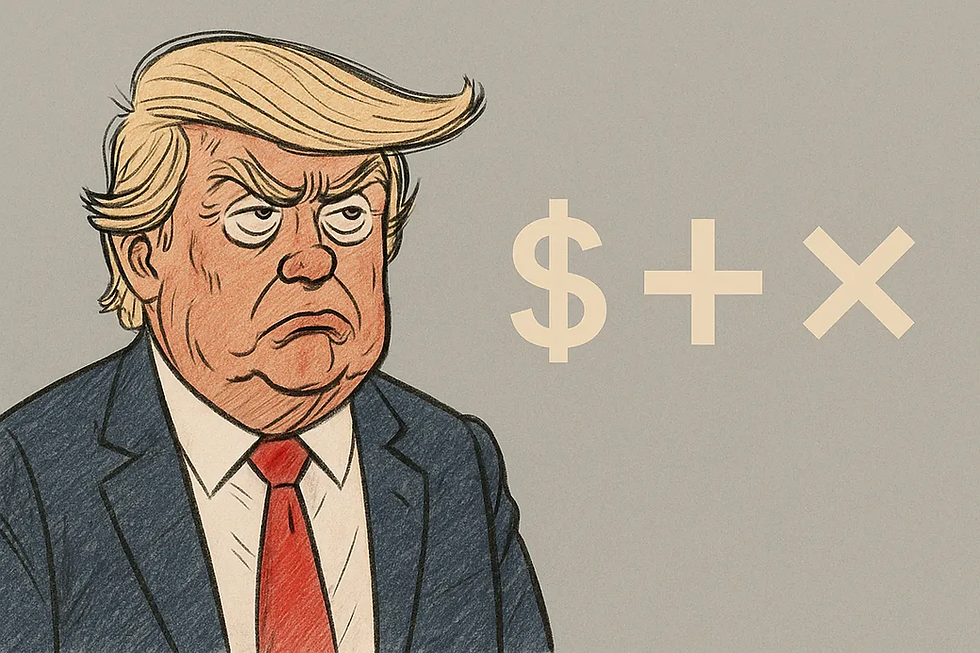
In the current landscape, humankind continues to navigate turbulent waters steered by a rudder controlled by the new god: the market. This impersonal entity has concentrated the planet’s goods and resources on one side of the boat, tipping it dangerously toward collapse. Capitalism, far from resolving the social, economic, and environmental ills it generates, continues to destroy everything it claims to protect.
We live immersed in a brutal paradox: technological advancement far exceeds the maturity of our collective consciousness, a consciousness that is still primitive and territorial, clinging to the primal instinct of accumulation and domination. Beneath the guise of pseudo-democracy and anarcho-capitalist policies that present themselves as liberating, lies a harsh reality where the law of the strongest reigns, and where capital dictates not only the economy but also morality and survival.
Mathematically, this rupture can be represented by the following formula:
Formula for social and ecological rupture: R = \frac{\sum_{i=1}^{n}(C_i — E_i)}{n}
Where R represents the social and ecological rupture, Ci the unsustainable consumption of resources per individual, and Ei the equity in access to basic resources. An increase in R reflects greater fragmentation and inequality.
Contemporary diseases, such as Alzheimer’s, multiple sclerosis, and autism, arise precisely from this profound rupture with our natural and social environment. Our DNA, permeated by latent viral agents, reflects and accelerates this evolutionary degeneration, which will soon equate these conditions with the prevalence of such common diseases as hypertension and diabetes.
It is ironic and painful to recognize that we are the species that most destroys its own habitat; our common home is being demolished by ourselves. The struggle for territory and resources remains the main driver of conflict, war, and unnecessary suffering, perpetuated by those who today set themselves up as warlords and messengers of death.
To change this reality, we propose a sustainable economic model based on equity:
Sustainability index formula: S = \frac{\sum_{i=1}^{n}(E_i + R_i)}{n}
Where S is the sustainability index, Ei represents social equity, and Ri represents sustainable resource management. The objective of the model is to maximize S by promoting the reduction of inequality and balanced resource management.
POVERTY ACCORDING TO THE FRIEDMAN MODEL
Milton Friedman, a free-market economist, proposed that a truly free economy would be capable of reducing poverty by generating wealth. However, current evidence shows that this model generates wealth but tends to concentrate it in a few hands, amplifying inequality and further impoverishing vulnerable sectors. The paradox of Friedman’s model lies in the fact that the more deregulated the market, the more likely it is that the poor will remain trapped in perpetual cycles of poverty, without real access to opportunities for social advancement or economic stability.
A sustainable and equitable approach, on the contrary, seeks to redistribute resources, guarantee equal opportunities, and establish clear social protection mechanisms, with the goal of breaking the vicious cycle of structural poverty inherited from current capitalism.
However, despite the bleak outlook described, there is still a latent hope: evolution knows no rigid limits, only alternatives defined by adaptation or extinction. The future will depend on our collective capacity to redefine the very concept of well-being and survival, definitively breaking with a model of infinite accumulation that today threatens to drown us under its own weight.
Capital, then, will not solve what capitalism continues to kill. The essential transformation must come from human beings, who are called to truly evolve, overcoming their primitive instincts and embracing a global and responsible consciousness.


Comentarios